
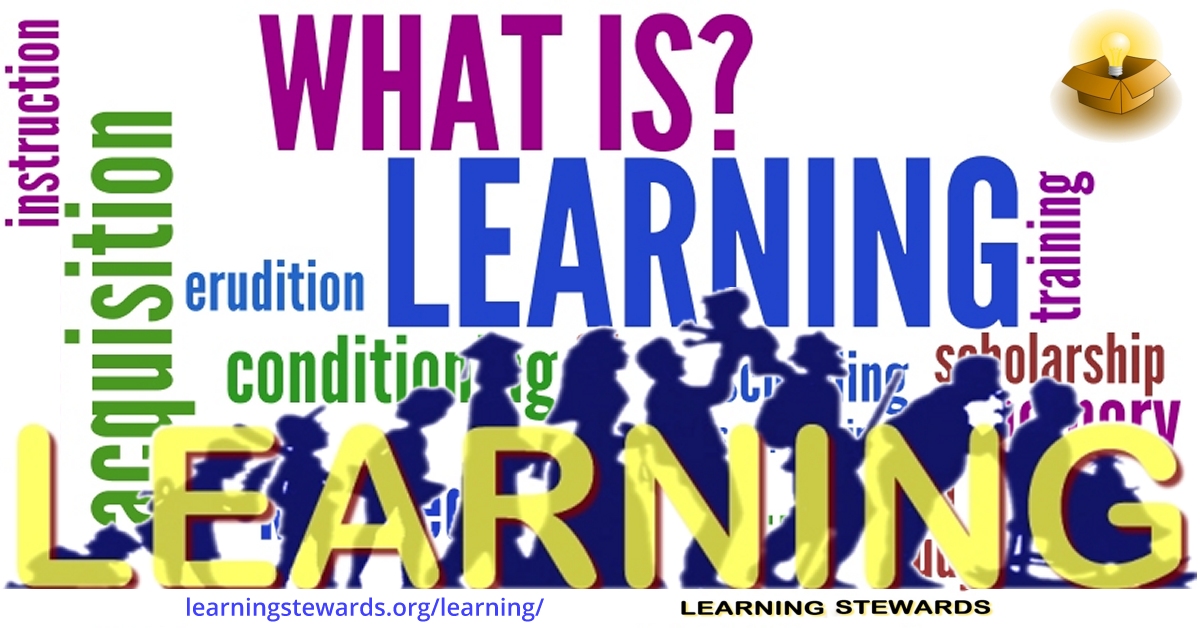
The role of learning in our lives is vastly beyond our common conception.
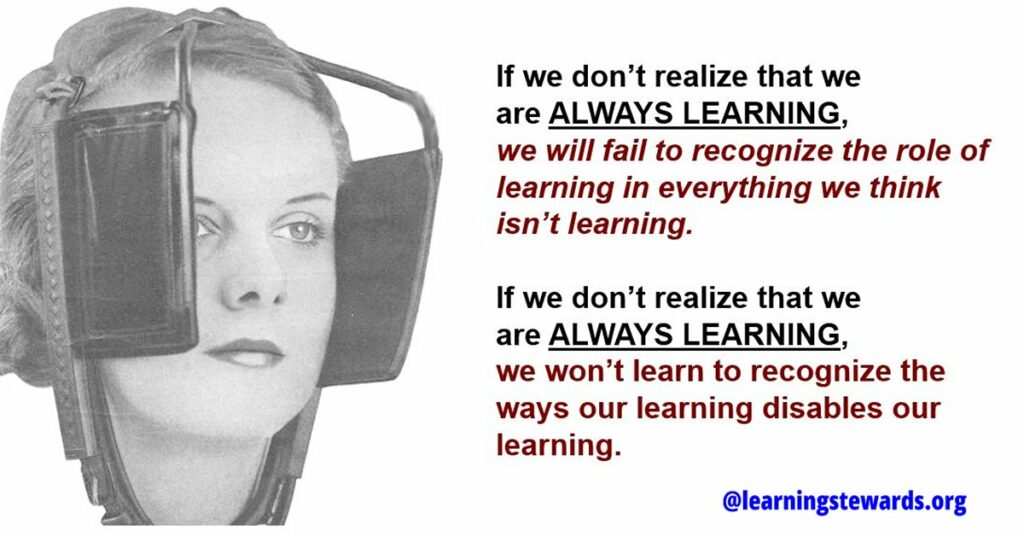
From birth to the last instant of life, we are continuously learning to become our future selves.
Everything we think, know, and believe, we learn. Our knowledge, skills, habits, attitudes, values, and ideals are learned. What aspect of yourself, your family, your culture, your society wasn’t shaped, if not determined, by learning?
Perhaps the most underappreciated word in our common vocabulary, the ways we commonly define learning profoundly limit and misorient the ways we think about educating and parenting:
Learning, noun
The act or experience of one that learns – Knowledge or skill acquired by instruction or study – Modification of a behavioral tendency by experience (as exposure to conditioning)
Learn, verb
transitive verb: To gain knowledge or understanding of or skill in by study, instruction, or experience (learn a trade) – MEMORIZE (learn the lines of a play) – To come to be able (learn to dance) – To come to realize (learned that honesty paid) – To come to know: HEAR (we just learned that he was ill)
intransitive verb: To acquire knowledge or skill or a behavioral tendency
Contrary to the above, learning is much more than acquiring or remembering knowledge, skills, behaviors, and experiences. Learning is the central dynamic of our health, personal achievement, relationships, jobs, economics, and politics – it’s the core exercise through which our intelligences (physical, spatial, sensory, kinesthetic, emotional, cognitive, linguistic, social, spiritual…) develop. For each and all of us, learning affects everything about how we know and experience ourselves and the worlds we live in. Learning is the central dynamic through which humans progress from newborn infants to geriatric adults.
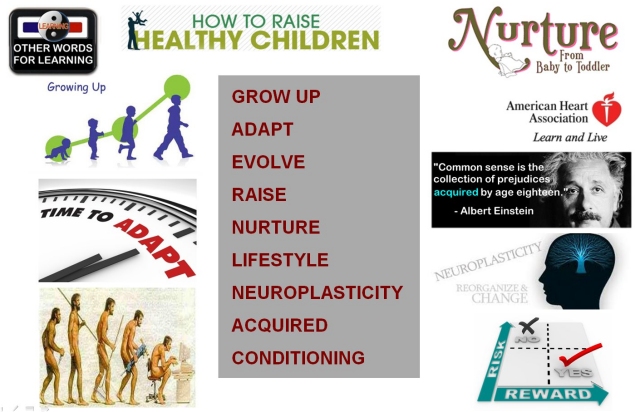
The following are other words for learning. The way we use them (and many others) obscures our appreciation for learning.
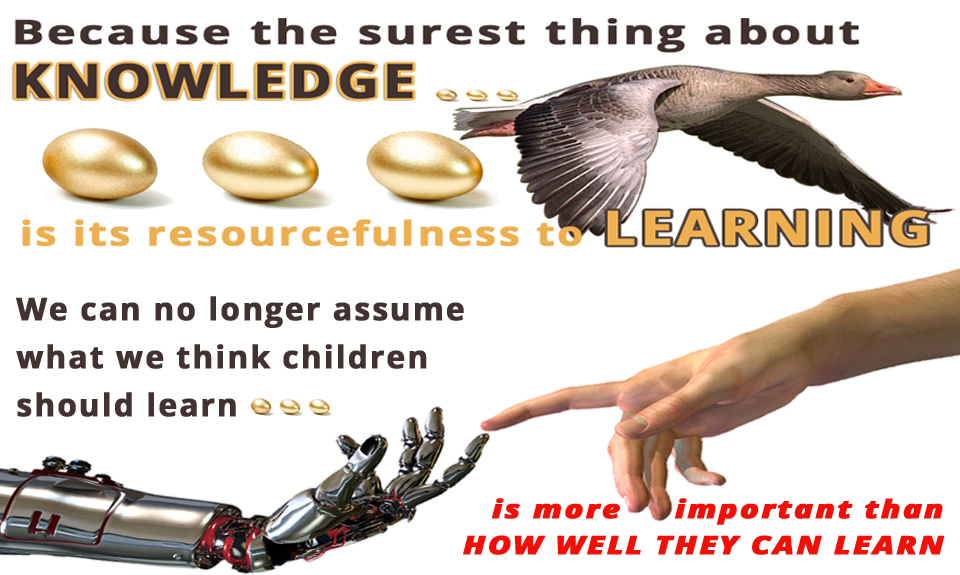
How you think about the relationship between learning and knowledge orients how you teach and parent. It used to be that learning was the means and knowledge was the goal. Now, in times of unprecedented change and ever greater uncertainty about the future, we have to turn that inside-out and make knowledge the means and learning the goal. Learning can include everything we’ve ever learned without being limited to it. Knowledge and skills are like golden eggs, learning is the golden goose.
Thinking is another word for learning. Thinking is learning through and with thought (what has been learned).
Any meaningful reform of education must begin by re-defining, socially-broadly, the word learning. Learning isn’t just an ancillary mental utility, learning is the central dynamic of being human.

changing how we think about learning changes everything.
This site is a continual work in process. Its pages are working drafts that will evolve over time. If our work interests you please share your thoughts, feedback, and comments and consider subscribing to receive updates about new posts and articles. If you think what we are doing is important, please consider contributing whatever you can to our non-profit work (see side panel). Together let’s ignite the dialogue.
Learning Stewards is a 501(c)(3) non-profit that depends on the support of people like you.
IT’S TAX DEDUCTIBLE
Learning Stewards
4211 Graf Dr.
Louisville, KY 40220
“The world we perceive is a dream we learn to have from a script we have not written.” (Exploring Affect p. 451; Tomkins). “I am, above all, what excites me.”
Here, to learn is defined by script formation. We know the world through script, script, =learning. Therefore, we are always learning. I think I posted this previously, but anyone that works with these Ideas finds that they keep being pulled back in the same hole of rediscovering the ideas from a different angle. Tompkins himself noted that.
“The world we perceive is a dream we learn to have from a script we have not written (but learned without realizing).” Scripts are learned temporal zippers/threads/orders that co-implicatively constell the orientations we are learning through.
Brian, I am unclear what you mean by: “anyone that works with these Ideas finds that they keep being pulled back in the same hole of rediscovering the ideas from a different angle”